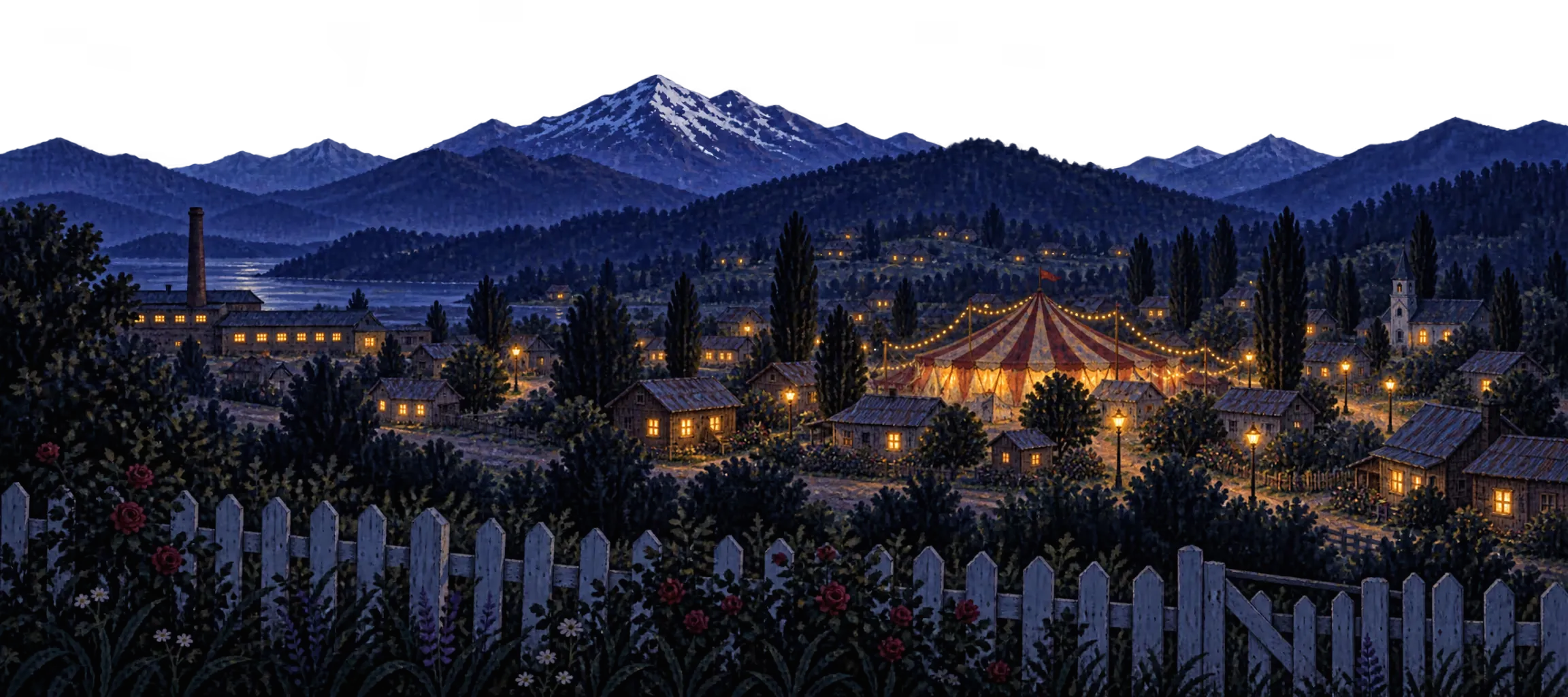
Pedrito was a very mischievous boy from a humble family, just eight years old. Blond with blue eyes that sparkled like little stars when he smiled, he lived with his father and his older sister Angela. His mother had passed away two years earlier due to terminal cancer, leaving an enormous void in that small home. But despite the sadness that sometimes visited them on silent nights, the three of them had learned to move forward, united by a deep love that strengthened them day by day.
Angela, fourteen years old, had become the pillar of the household. She, with a maturity that didn’t correspond to her age, took care of the household chores and helped her dad care for Pedrito. Every morning she woke up early to prepare breakfast, every afternoon she checked her little brother’s homework, every night she made sure everything was in order before going to sleep. Despite the responsibilities she had to assume, she never stopped being an excellent student. Both siblings stood out for their academic excellence, and their father felt immensely proud of them.
The children’s father, Don Roberto, was a hardworking and dedicated man. Employed at a factory on the outskirts of town, he left every morning when the sun barely peeked over the horizon and returned at nightfall, tired but always with a smile for his children. He juggled his long work hours and the needs of Pedrito and Angela, but never, not for an instant, did he make them feel abandoned. Sundays were sacred: that day he didn’t work and devoted it entirely to his little ones. They prepared lunch together, played in the neighborhood park, or simply sat on the living room couch watching movies while sharing popcorn.
One day, at the factory, Don Roberto began to have more frequent conversations with María, a coworker. She was a woman with a kind smile and warm eyes, who worked in the packaging department. At first they were just cordial greetings in the hallways, then conversations during lunch in the factory cafeteria, and little by little, a genuine friendship began to blossom between them.
María had heard Don Roberto speak with such love about his children that she felt as if she already knew them. “My Angela is so responsible,” he would say with pride. “And Pedrito, oh, that boy is a whirlwind of energy, always inventing mischief, but he has a heart of gold.” Don Roberto’s words were always infused with tenderness when he mentioned his little ones, and María admired this man’s dedication to his family.
Several months of friendship passed, and Don Roberto realized that the feelings he had toward María had evolved. She was no longer just a coworker; she was someone he trusted, someone who made him smile on difficult days, someone whose presence brightened his gray afternoons at the factory. After thinking about it a lot and talking at length with María about his fears and hopes, he decided it was time for her to meet his children.
One Saturday afternoon, Don Roberto arrived home accompanied by María. The children, who were playing in the backyard, looked up surprised when their father opened the garden door.
“Children,” said Don Roberto in a soft voice, “I want to introduce you to someone very special. This is María, a friend from work.”
María crouched down a little to be at Pedrito’s height and extended her hand with a warm smile. “Hello, Pedrito. Your dad has told me so much about you that I feel like we’re already friends.”
The boy, shy at first, shook her hand and then ran to hide behind his sister. Angela, more serene, politely greeted María and invited them to come inside the house.

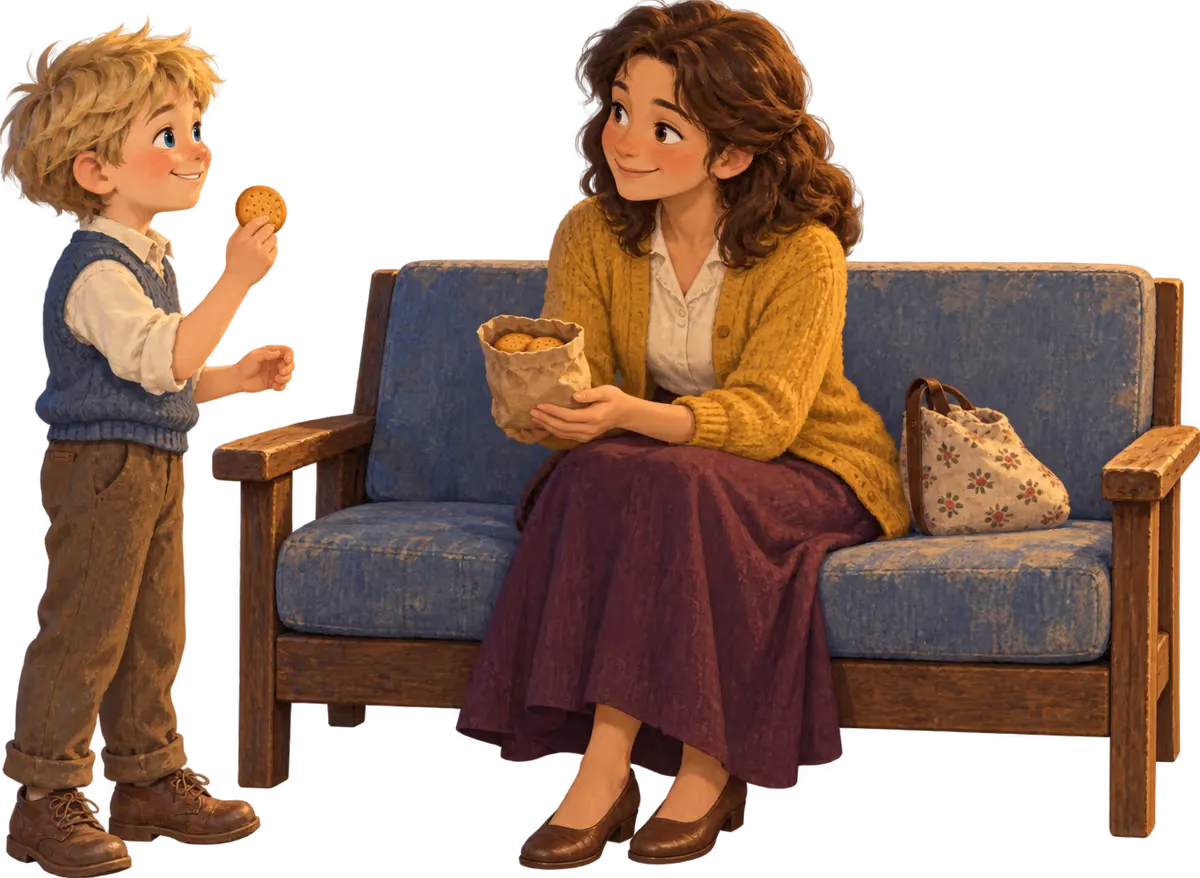

That first visit was special. María didn’t try to force a connection; she simply sat on the couch and listened to the children talk about their school, their games, their dreams. Before leaving, she took out of her bag a small bag of homemade sweets she had prepared especially for them: peanut brittle and alfajores that melted in your mouth.
“These are my favorite sweets,” she told them with a wink. “And I hope they’ll be yours too.”
Pedrito, who had already forgotten his initial shyness, bit into an alfajor and his eyes lit up. “They’re delicious!” he exclaimed with his mouth full, and everyone laughed.
From that day on, María began to visit the home more frequently. Each visit brought small details: sometimes it was sweets, other times a storybook for Pedrito, or a crossword magazine for Angela. Little by little, her presence became natural, as if she had always belonged to that small home full of love.
About a year passed, and one night, after the children had gone to bed, Don Roberto sat down with them at the kitchen table. His face showed a mixture of nervousness and hope.
“My loves,” he began, taking Angela and Pedrito’s hands in his, “I want to talk to you about something very important. You know how much I love you, right? And you know that everything I do is thinking about your happiness.”
The children nodded, looking at him attentively.
“María… well, María has become very important to me. And I think she loves you both very much too. I’ve been thinking, and…” he paused, took a deep breath. “How would you feel about the idea of María coming to live with us? But only if you agree. Your opinion is the most important thing to me.”
The children looked at each other. In their eyes was a flash of understanding that went beyond their years. Angela was the first to speak.
“Dad,” she said in a soft but firm voice, “we see you happy when you’re with María. And that makes us happy too. Mom always told us to take care of each other, and to support each other in difficult moments. If María makes you happy, Dad, then we accept her with all our hearts.”
Pedrito nodded vigorously. “Yes, Dad! And besides, she makes really delicious alfajores!”
Don Roberto felt tears spring to his eyes. He hugged his children tightly, thanking heaven for having given him two such wonderful beings.
Days later, María arrived with her suitcases. There weren’t many; she had always lived simply, valuing people more than material possessions. The children received her with sincere hugs. Angela helped her carry her things to the bedroom she would now share with her father, and Pedrito insisted on showing her every corner of the house, from his collection of toy cars to the tree in the yard where he sometimes hid when playing hide and seek.
That night, the four of them prepared dinner together. María, wearing an apron, taught Angela her secret empanada recipe, while Don Roberto and Pedrito took care of making a salad (which ended up being more of a fun mess than a culinary work, but no one complained). The kitchen filled with laughter, the delicious aroma of empanadas browning in the oven, and a warmth that hadn’t been felt in that house for a long time.
During dinner, shared at the dining room table with a tablecloth that Angela had put out especially for the occasion, they talked about plans for the coming days, about school routines, about small everyday things that somehow no longer seemed so small.
At the end of dinner, Angela helped with the dishes as was her custom. María offered to do it alone, but the girl insisted: “This way we’ll get to know each other better,” she said with a smile. While they washed the dishes side by side, they talked about many things: about school, about Angela’s friends, about her dreams of becoming a teacher someday.
“You know?” Angela confessed to her while drying a plate, “I’m a little afraid of forgetting Mom.”
María stopped washing and looked at the girl with infinite tenderness. “Angela, my love, listen to me carefully: I’m not here to replace your mom. No one could do that. Your mom will live forever in your heart, in your memories, in all the good things she taught you. I just want to be someone else who loves you, who takes care of you, who’s here when you need me. Is that okay?”
Angela nodded, and for the first time in a long time, she felt a weight lift from her shoulders.
After putting everything away, Angela stopped by Pedrito’s room. The boy was already in his pajamas, sitting on his bed surrounded by books and toys. Angela helped him organize his uniform for the next day and prepare his backpack.
“Are you happy that María is here?” she asked him while folding his school sweater.
“Yes,” Pedrito answered with a big smile. “She’s very nice. And Dad looks happier, doesn’t he?”
“Yes, little brother. Dad is happier.”
Angela gave him a little kiss on the forehead. “Good night, Pedrito. Have beautiful dreams.”
“Good night, Angelita. Dream with little angels,” the boy replied with his cheerful little voice.
Angela turned off the light and headed to her own bedroom, but first she stopped by her dad’s room. She knocked softly on the door and entered to say good night to him and María.
“Rest well,” she said with a sincere smile.
Don Roberto got up and hugged his daughter. “God bless you, my daughter. Tomorrow will be another day full of opportunities.” He gave her a kiss on the forehead, just as he always did, and Angela felt that, despite all the changes, some beautiful things would remain forever.
The girl went to her room, left her clothes organized for the next day, her backpack prepared by the door. Then she brushed her teeth in front of the bathroom mirror, looking at her reflection and feeling in her heart a mixture of nostalgia and hope. She lay down in her bed, looked out the window at the stars twinkling in the night sky, and gave thanks to God for her family, for the beautiful memories of her mother, and for the new people coming to fill her life with love. She fell asleep with a smile on her lips.
The next day, Angela woke up early, as was her custom. She first stopped by Pedrito’s room and woke him tenderly, giving him a little kiss on the cheek.
“Wake up, Pedrito. We have to go to school.”
The boy stretched, yawning loudly, and followed his sister to the bathroom. She turned on the shower, tested that the water was at the perfect temperature, and helped her little brother shower. Pedrito, always playful, splashed water everywhere while soaping up, and Angela couldn’t help but laugh.
“You’re an earthquake,” she told him while passing him the towel.
The boy, wrapped in the towel like it was a superhero cape, ran happily to his room to get dressed. Angela followed him to make sure he put on his uniform correctly and didn’t end up with his shirt backwards as had happened more than once.
Meanwhile, in the kitchen, Don Roberto and María worked together preparing breakfast. The aroma of freshly brewed coffee and toasted bread filled the house. When Angela and Pedrito arrived in the kitchen, they found the table set with butter, jam, orange juice, and steaming pancakes.
“Pancakes!” Pedrito shouted excitedly, jumping in his chair.
They all had breakfast together, talking about what each one would do that day. Don Roberto had a shift at the factory from early morning, María would go after midday, and the children had a full day of classes.
At the end of breakfast, the children left hand in hand with their father, heading to the school that was a few blocks from their house. It was a walk that Don Roberto treasured: those minutes walking with his children, listening to them talk, feeling them close.
Upon arriving at school, the children entered very happily. Each one greeted their teachers and classmates, heading to their respective classrooms. Don Roberto stayed for a moment at the door, watching them walk away, before heading to his work.
In their classrooms, both Pedrito and Angela paid attention to the different subjects. Pedrito, despite being mischievous, was a brilliant boy who absorbed knowledge like a sponge. Angela, for her part, continued to stand out as one of the best students in her class.
At the end of the school day, Angela waited as always for her little brother in the school yard. She saw him come running out of his classroom, with his backpack bouncing on his back and a huge smile on his face.
“Angelita! Look what I made!” He showed her a drawing he had made in art class: a house with four people holding hands in front of it. “It’s us: Dad, you, me, and María.”
Angela felt her eyes fill with tears, but they were happy tears. “It’s beautiful, Pedrito.”
They walked back home, accompanied by Doña Teresa, the mother of one of Pedrito’s classmates who lived on the same street. During the walk, the children talked animatedly about their school day, about recess games, about the homework they had to do.
Upon arriving home, they found María waiting for them with the door open and lunch almost ready.
“My children!” she greeted them with a warm smile. “How was school?”
“Very good!” they both answered in unison.
“Well then, change your clothes and come have lunch. I prepared something special for you.”
The children obeyed immediately. They changed out of their uniforms into comfortable clothes, went to the bathroom to wash their hands with soap, and then headed to the dining room where the table was already set.
María appeared from the kitchen with steaming plates: she had prepared cazuela, a traditional stew full of fresh vegetables and tender meat that melted in your mouth. The aroma was irresistible.
“It smells delicious!” exclaimed Pedrito, quickly sitting in his chair.
They ate with pleasure, enjoying every bite. María told them stories from when she was a child, about mischief she did with her siblings, and the children listened fascinated. After the main course, María brought a delicious dessert: homemade flan with caramel, soft as a cloud.
After lunch, Angela helped María with the dishes. A comfortable routine had been established between them, a silent but pleasant company while they washed, dried, and put everything away.
During the afternoon, Angela helped Pedrito with his homework. They sat together at the dining room table, with notebooks and pencils scattered about. The boy had to do math exercises and write a short composition about “My Family.”
Pedrito thought for a long time, biting the end of his pencil, before beginning to write in his large, somewhat messy handwriting: “My family is the most beautiful thing in the world. I have my dad who works hard to give us everything. I have my sister Angela who takes care of me and helps me. And now we have María, who cooks well and loves us a lot.”
Angela, reading over her brother’s shoulder, felt her heart swell with love.
After finishing their homework, Pedrito went to his room to play for a while, while Angela studied for a science test she would have the next day. Half an hour later, she put her things away and sat for a moment by her bedroom window.
From there, she looked at the small backyard. In one corner, near the white painted wooden fence, red roses were growing. Her mother had planted them years ago, and Angela had taken care of them with dedication, watering them every afternoon, pruning the dry leaves, talking to them as if they could hear her. Those roses were her connection to her mother’s memory, and each flower that bloomed was like a message of love from heaven.
At that moment, Pedrito came running into her room, interrupting her thoughts.
“Sister, sister!” he shouted excitedly, jumping like a little rabbit. “María is inviting us to go to the circus! To the circus in the center of town!”
Angela looked at him surprised. “To the circus? Really?”
“Yes! Let’s go, let’s go! There are clowns and everything!”
The two children ran downstairs and found María in the kitchen, smiling at Pedrito’s overflowing enthusiasm.
“It’s true,” she confirmed. “I thought it would be nice to do something special together. What do you say?”
“Yes!” shouted Pedrito.
“It’s a very nice idea,” added Angela with a smile.
They got ready quickly, putting on their jackets and hats, as the weather was a bit cold that afternoon. María checked that the children had their scarves and were well bundled up before leaving.
The three of them walked to the center of town, where a traveling circus had been set up. The tent was enormous, brightly colored and visible from far away. Even from outside you could hear laughter and cheerful music.
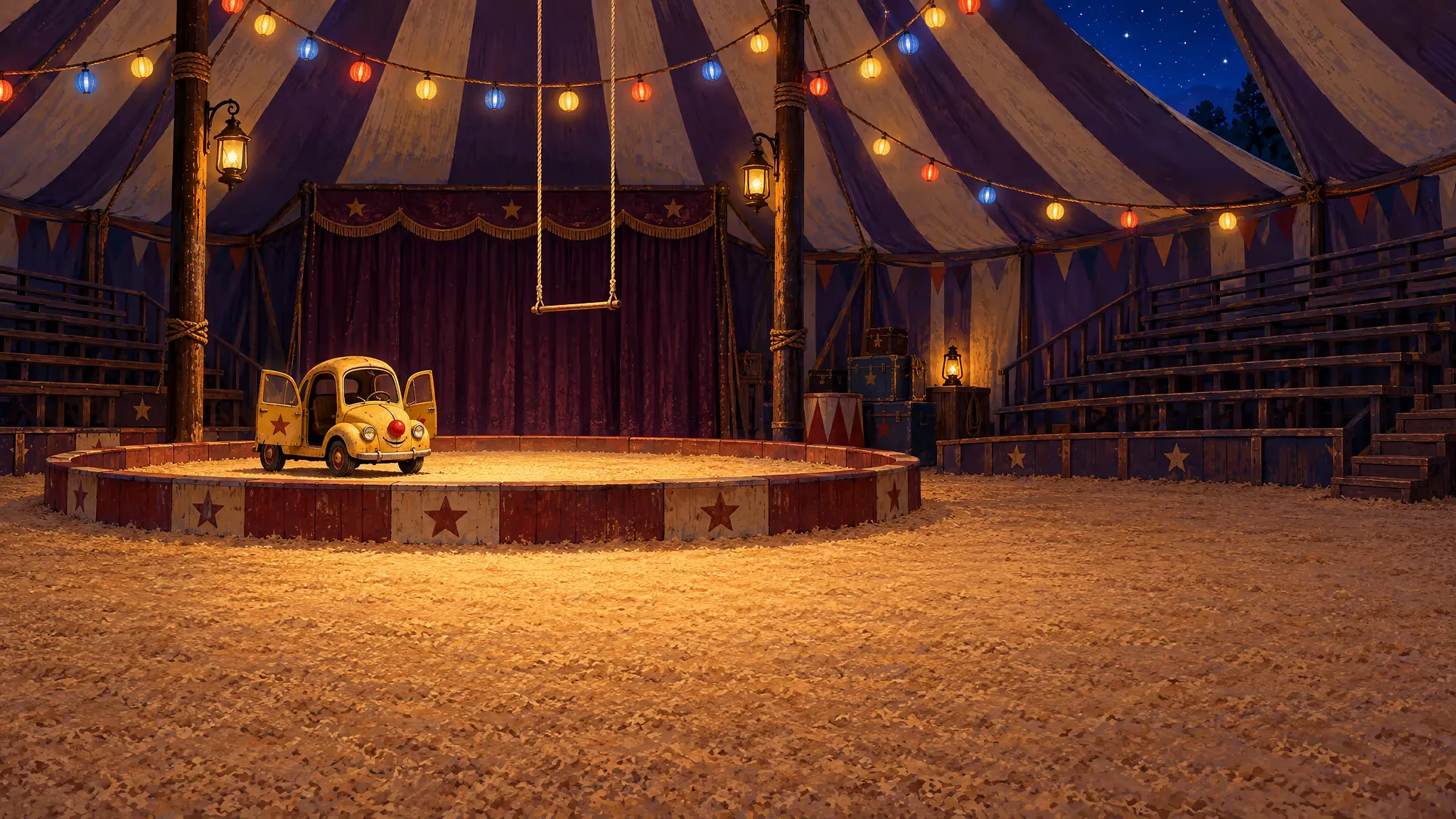
They bought their tickets and entered. The inside of the tent was magical: colored lights spun on the ceiling, sawdust on the floor gave off a characteristic aroma, and the bleachers were filled with excited families.
They found seats near the front and settled in just as the show was beginning. Trapeze artists who flew through the air with incredible grace paraded by, jugglers who spun dozens of objects without any falling, a tamer who worked with majestic lions that obeyed every command, and white horses that danced to the rhythm of the music.
But what really left Pedrito with his mouth open were the clowns. They entered the stage in a tiny car from which they emerged one after another, as if the vehicle were magical. They wore giant red noses, enormous shoes that made noise when they walked, and wigs of impossible colors. Their routines were hilarious: they threw cream pies, slipped on banana peels, juggled ridiculously large objects.
Pedrito laughed out loud, with his whole body, with a joy so pure it was contagious to everyone around him. Angela and María also laughed, but from time to time they looked at each other and smiled seeing the absolute happiness on the boy’s face.
During one of the intermissions, Pedrito turned to his sister and María, with his eyes shining with excitement.
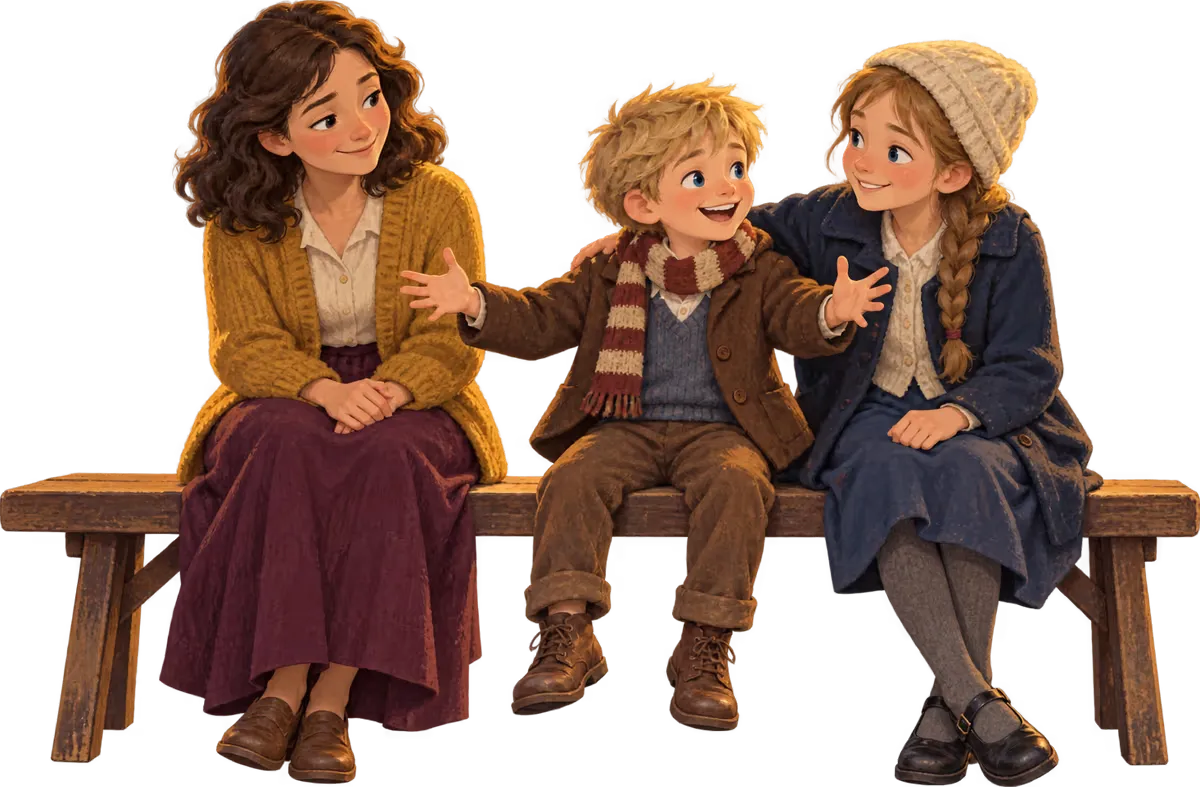

“I want to be a clown when I grow up,” he declared with complete seriousness, despite still having a huge smile on his face. “I want to make people laugh like that, I want to see them happy.”
Angela hugged him affectionately. “You’re incredible, little brother.”
María also hugged him. “If that’s your dream, Pedrito, then I’m sure you’re going to fulfill it.”
At the end of the circus, they left with hearts full of joy. Night had fallen and the town streets were illuminated by old lampposts that gave the place a nostalgic air. On the way, they stopped at Don Ramiro’s store on their street corner and bought some delicious pastries filled with dulce de leche to have with Don Roberto at tea time when he got home from work.
Upon arriving home, they entered happy and with cold cheeks. María went to the kitchen to prepare tea, heating water and arranging the pastries on a pretty plate. Angela, as usual, helped her, setting the table with cups, napkins, and spoons.
At that moment Don Roberto arrived from work. He came tired, with his overalls stained with factory grease, but his face lit up seeing his family gathered.
Pedrito ran to greet him, almost knocking him over in his enthusiasm.
“Dad, Dad! I have to tell you! We went to the circus with María! There were clowns, Dad! And trapeze artists! And lions!”
Don Roberto knelt down to be at his son’s height and affectionately ruffled his hair.
“How wonderful, son. I’m so glad you had a good time.”
Pedrito took a breath and then let out the declaration he had been keeping during the whole way home: “Dad, when I grow up I want to be a clown. I want to make people laugh, I want everyone to be happy like I was today.”
Don Roberto looked into his eyes, those little blue eyes full of innocence and determination, and felt his heart fill with tenderness.
“That’s very good, Pedrito,” he told him in a soft but firm voice. “If that’s your dream, I’m going to support you in everything. Just like I support your sister in everything she wants to do. Dreams are important, son. And I’ll always be here to help you fulfill yours.”
Pedrito hugged him tightly, and Angela, who was watching them from the kitchen door, felt tears well up in her eyes. She had the best dad in the world.
The four of them sat around the table, drinking hot tea and eating the delicious pastries while talking about the circus, about the day at the factory, about plans for the weekend. It was a simple, everyday scene, but it was full of love.
And so the days, weeks, and months passed. María naturally became, without forcing anything, the maternal figure the children needed. She wasn’t replacing their biological mother; she was filling a space with her own love, with her own way of caring for them, with her own way of being present.
She woke them in the mornings with affection, prepared nutritious breakfasts, made sure their uniforms were clean and ironed. She waited for them when they returned from school with hot lunches. She helped them with homework when they needed it. She listened to them when they had problems. She consoled them when they were sad. She hugged them when they needed to feel loved.
And they, Pedrito and Angela, accepted her with all their hearts. Because true love isn’t imposed; it simply blossoms when conditions are right. And in that small home, conditions were perfect: there was respect, there was affection, there was understanding, there was a family that, although not conventional, was real and beautiful.
The children grew up in an environment full of love and understanding. Don Roberto and María worked together to create a home where both children could flourish, where their talents were recognized, where their dreams were respected.
And Pedrito, oh, Pedrito continued with his fixed idea. At every opportunity he had, he mentioned his dream of being a clown. He said it at the table during dinners, he wrote it in his school compositions, he drew it in his art notebooks.
One day, when Pedrito was nine years old, he came home from school more excited than ever, waving a sheet of paper in the air.
“Dad, María, Angela!” he shouted from the door. “We have a special activity at school! We all have to go in a costume! It’s Children’s Day and we’re going to have a party!”
That night, during dinner, Pedrito couldn’t stop talking about the event. He asked anxiously what costume he would have, if it could be a clown costume, if it would be pretty.
Don Roberto and María looked at each other knowingly, and smiled.
“Don’t worry, Pedrito,” María told him tenderly. “We’re going to take care of your costume. And Angela’s too.”
“But what will it be?” the boy insisted, unable to contain his curiosity.
“It’s a surprise,” his father answered with a wink. “But you’re going to love it. Trust us.”
The following days were anxious ones for Pedrito. Every afternoon he came home from school asking about his costume, and every time his father and María told him to be patient.
What Pedrito didn’t know was that María, at night, after the children had fallen asleep, stayed in the living room with her portable sewing machine, working carefully on the costumes. She had bought shiny fabrics, colorful buttons, ribbons, and trimmings. Don Roberto helped her by taking measurements, cutting patterns, suggesting details.
For Angela, María was making a beautiful princess dress: sky-blue fabric with silver sparkles, puffed sleeves, a full skirt that would move like a cloud when the girl twirled. She was embroidering little stars on the bodice, and she had bought a silver tiara that would complete the outfit.
But Pedrito’s costume was something special. María had found a fabric with big polka dots, colorful and cheerful. She was creating a complete clown suit: wide pants with suspenders, a shirt with a big collar and ruffles, and she had even made an enormous bow tie that spun when you wound it up. Don Roberto had gotten a curly orange wig and a red foam nose.
The night before the school event, María sewed the last stitches. Don Roberto checked that everything was in order. They wrapped both costumes carefully and put them in each child’s room, at the foot of their beds, so they would find them when they woke up.
When Pedrito opened his eyes that morning and saw the package wrapped in gift paper with a red bow, he jumped out of bed as if launched by a spring. His hands trembled with excitement as he tore the paper.
And then he saw it.
His clown costume.
The shout of joy that Pedrito let out echoed through the whole house. It was a shout of pure happiness, of dreams beginning to come true, of love received and treasured.
Behind the half-open door, Don Roberto, María, and Angela watched him in silence, with huge smiles on their faces. Seeing Pedrito’s happiness was the best gift they could receive.
The boy ran to the bathroom, showered on his own for the first time without anyone having to remind him, and returned to his room to get dressed. He put on the costume with reverent care, as if it were the most valuable clothing in the world. The pants fit him perfectly, the shirt was comfortable, the wig gave him a hilarious look. He put on the red nose and looked at himself in the mirror.
He wasn’t just a boy in a costume. He was a clown. It was his dream taking shape.
He ran out to the kitchen, where his family was waiting for him. When they saw him, everyone burst into applause.
“You look incredible!” exclaimed Angela, who was also wearing her princess dress and looked radiant.
“You look like a real clown,” added Don Roberto with pride.
Pedrito hugged María and his father so tightly that he almost made them lose their balance. “Thank you, thank you, thank you,” he repeated over and over, his voice breaking with emotion.
After a quick breakfast, they left for school. The walk was a procession of joy: Pedrito greeted all the neighbors with exaggerated clown gestures, pretended to fall, waved his arms comically. Angela walked beside him, dignified and elegant like a true princess.
Upon arriving at school, the yard was an explosion of color and joy. There were children dressed as superheroes, as animals, as storybook characters. But Pedrito stood out in his clown costume.
Miss Paula, his teacher, came over to him with a huge smile. She was a young woman with kind eyes, who had always supported her students’ dreams.
“Pedrito,” she said, kneeling in front of him, “you look spectacular. You’re a real clown.”
The boy, with all the seriousness he could muster despite his comical outfit, answered her: “Miss Paula, when I grow up I want to be a real clown. I want to make people laugh, I want to brighten their day.”
The teacher put a hand on the boy’s shoulder and looked into his eyes. “Pedrito, if that’s your dream, I’m sure you’re going to fulfill it. Do you know why? Because you have something not everyone has: passion. When you talk about being a clown, your eyes shine. And that’s the most important thing. If you love something with all your heart, and if you persevere, if you work hard for it, no dream is impossible.”
“Really, Miss?”
“Really, Pedrito. So it will be.”
“So it will be, so it will be,” the boy repeated like a mantra, with a smile that lit up his face.
Throughout the whole day, Pedrito showed off in his outfit. He took part in every game, in every activity, always making his classmates laugh with improvised clowning. He discovered that he had a natural gift for physical humor, for exaggerated gestures, for finding a way to draw a smile from even the shyest children.
At the end of the festivities, the children returned to their homes, tired but happy. Pedrito and Angela arrived home still wearing their costumes, refusing to take them off.
The first thing they did when they came in was look for María, who was waiting for them in the living room.
The two children approached her with slow, almost shy steps. They looked at each other, as if searching for courage, and then Pedrito spoke first:
“María,” he began in a soft voice, “we want to thank you. You’ve been very good to us since the first day. You’ve taken care of us, you’ve loved us…”
Angela continued: “You’ve never made us feel like an obligation. You’ve always treated us with true affection.”
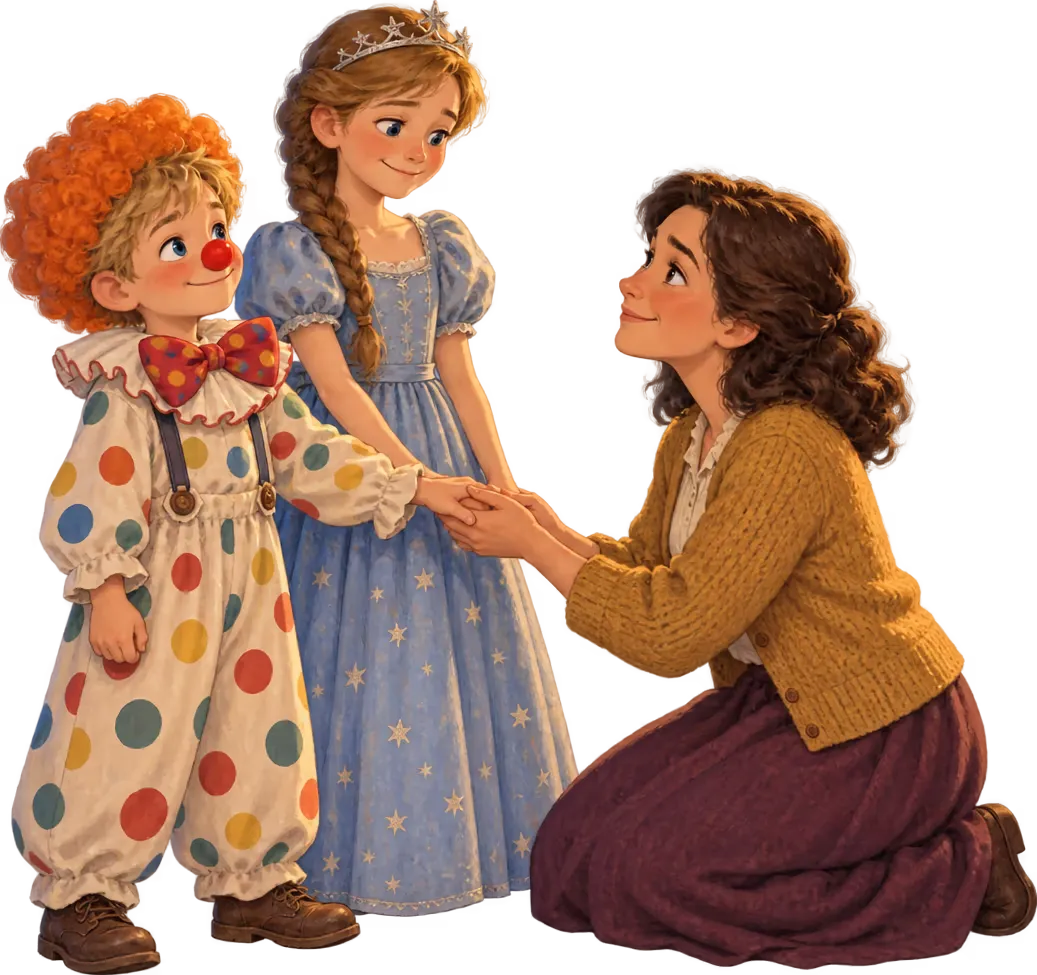

Pedrito took a breath and let out the question that had been forming in his heart for months: “Can we call you Mom? Can we be your children?”
María felt tears spring to her eyes. She knelt in front of the children and took them by the hands.
“My loves,” she said in a voice full of emotion, “I want you to understand something very important. I’m not your mother by blood. You had a wonderful mom who loved you with all her heart, and who still loves you from heaven. I’m not here to replace her. No one could do that.”
The children looked at her attentively, without interrupting.
“But,” María continued, squeezing their hands tenderly, “I love you very much. I love you as if you were my own children, because love doesn’t depend only on blood. Love is built day by day, with care, with presence, with small gestures. And you have earned all my love. I will always love you, I will always take care of you. You can call me whatever feels most comfortable to you. If you want to call me Mom, my heart will fill with joy. And if you prefer to call me María, that’s fine too. What matters is the affection we have for each other.”
Angela and Pedrito threw themselves into her arms, and the three of them hugged, crying and laughing at the same time. It was a moment of healing, of acceptance, of love expanding to include someone new without forgetting the one who was no longer there.
When Don Roberto arrived from work that evening, María told him what had happened. The man felt his heart overflow with gratitude. He hugged María tightly.
“You’ve earned all of this,” he told her in a voice full of emotion. “Because you’ve shown us that you’re an extraordinary woman. You’re a good partner, a good mother to my children. We’re always going to love you, we’re going to take care of you, because you deserve it. Thank you for coming into our lives.”
That night, the four of them shared a special dinner that Don Roberto and María had prepared together: roast chicken with golden potatoes and fresh salad, and for dessert, the children’s favorite chocolate cake.
They sat around the table, holding hands, and Don Roberto offered a prayer of thanks. “Thank you, God, for this family. For the love that unites us, for the dreams we share, for each day you give us together. Watch over us and guide our steps. Amen.”
“Amen,” they all repeated in unison.
They ate dinner amid laughter and conversation, sharing stories from the day, making plans for the weekend. After dinner, they went to sleep with hearts full of gratitude and peace, thankful for all the happiness that reigned in that home.
The years passed, and with them came beautiful changes. Pedrito grew up, but his dream never changed. As he moved through elementary school and then high school, whenever there was an activity that called for costumes or performances, Pedrito always chose to be a clown.
María, faithful to her love for him, made him new clown suits as the boy grew. Each one was more elaborate than the last: more and more colorful pants, shirts with more creative details, funnier accessories.
At every school show, at every town festival, at every opportunity he had, Pedrito dressed up as a clown. And not only that: he began to study the art. He read books about famous clowns, watched videos of great circus artists, practiced juggling in his backyard, learned simple magic tricks, perfected his comic falls.
His classmates at first saw him as a weird kid, obsessed with clowns. But over time, they began to admire him. Because Pedrito didn’t just talk about his dream; he worked for it. He made an effort, he dedicated himself, he constantly improved.
Angela, meanwhile, had grown to become a beautiful and brilliant young woman. She fulfilled her own dream of studying education, and became an elementary school teacher. Whenever Pedrito needed advice on how to connect with an audience, on how to understand what people needed to be happy, he consulted with his sister.
Don Roberto and María proudly watched as their two children grew and flourished. The home they had built together, with love, patience, and dedication, had borne beautiful fruit.
And then came the day that would change everything.
Pedrito was now twenty-five years old. He had become a handsome young man, tall, with the same blond hair and blue eyes of his childhood, but now with a look that reflected determination and purpose. He had studied acting and performing arts at university, had worked in various circuses during summers, had perfected his art.
One Sunday afternoon, he gathered his family in the living room. Don Roberto and María, now with some silver hairs but with hearts just as young, sat on the couch. Angela arrived from her nearby apartment, intrigued by the family meeting.
Pedrito stood in front of them, hands in his pockets, visibly nervous but excited.
“Dad, Mom María, Angela,” he began, looking at each one, “you know that for as long as I can remember, since that day when I was eight years old and we went to the circus, I’ve had a dream. A dream that you have never belittled, that you have always supported, that you have nourished with your love and confidence.”
Don Roberto nodded. “Your dream of being a clown.”
“Exactly,” Pedrito confirmed with a smile. “But now that I’m older, now that I’m a grown man, now that I have my profession and experience, I want to fulfill something bigger. Something that goes beyond me.”
He looked at them intensely, and continued: “I want to build something. I want to build a school, a Clown School. A place where other children and young people who have the same dream as me can learn the art. Where they teach not only how to make people laugh, but to understand that being a clown is bringing joy to a world that is sometimes very hard. It’s a noble profession, it’s an art, it’s a vocation.”
María put her hands to her heart. Angela had shining eyes with emotion.
“I’ve been saving for years,” explained Pedrito. “I’ve worked in shows, at children’s parties, at events. I’ve saved some money. But it’s not enough for a project of this magnitude. I need help. I need you.”
Don Roberto got up and walked toward his son. “Pedrito, my son, from the day you were born I’ve known you were special. And this project, this Clown School, is proof that you not only dream big, but you want to share your passion with others. Count on us. Count on every peso I can contribute, on every hour of work I can give, on all my support.”
María joined the hug. “My dear boy, I’m also going to help you in everything I can. This dream is beautiful, and it deserves to come true.”
Angela hugged her brother tightly. “I’m going to do a campaign at my school. I’m going to talk to other teachers, to parents. We’re going to raise funds. You’re not alone in this, little brother. You never have been.”
The following weeks were a whirlwind of activity. Don Roberto talked to his coworkers at the factory, many of whom made donations. María organized pastry and empanada sales in the neighborhood, raising money little by little. Angela created a social media campaign that went viral: “Let’s help Pedrito fulfill his dream and the dream of many children.”
Relatives, friends, acquaintances, even people who had never met Pedrito but were moved by his story, began to contribute. Some gave money, others offered construction materials, others promised their volunteer work.
Pedrito found a plot of land on the outskirts of town, a spacious space with old trees that would provide shade for future students. With the support of an architect friend who did the plans without charging, they designed a beautiful building: spacious classrooms, a large hall with a stage for practice, green areas, even a small circus tent.
Construction took two years. They were two years of hard work, challenges, moments when it seemed impossible to move forward. But the family never gave up. Don Roberto went after work to help with construction. María organized lunches for volunteers. Angela continued her fundraising campaign.
And finally, on a bright spring day, Pedrito’s Clown School opened its doors.
The building was beautiful: painted in cheerful colors, with murals of famous clowns on the exterior walls, with a huge sign that said: “Pedrito Circus Arts and Clown School - Where dreams come true.”
The inauguration ceremony was emotional. Everyone who had helped attended, all the families from town, Pedrito’s former teachers, childhood friends. Even professional clowns from nearby circuses appeared who had heard about the school and wanted to offer their support.
Pedrito, dressed in his best clown suit, the one María had made especially for this occasion, stood in front of everyone with a microphone in his hand.
“Dear friends, dear family,” he began, and his voice broke slightly with emotion, “today is a day I’ve dreamed of since I was eight years old. But this dream isn’t just mine. It belongs to all of you, who believed in me. It belongs to my dad, who always told me he would support me in everything. It belongs to my mom María, who made me my first clown costume and has made all the others since then. It belongs to my sister Angela, who never stopped believing. It belongs to every person who donated even a single coin to make this possible.”
He paused, looking at the building behind him with pride.
“This school isn’t just to teach juggling or how to fall comically. It’s to teach something more important: that bringing joy to others is one of the noblest purposes we can have in life. That in a world full of sadness, being able to bring out a smile is a superpower. That clowns aren’t just entertainment; they’re healers of the soul.”
Tears ran down Don Roberto and María’s cheeks. Angela cried openly, proud of her brother.
“So today,” continued Pedrito, “I’m not just inaugurating a school. Today I’m fulfilling one of my greatest dreams. And I’m doing it knowing that, thanks to you, I’m going to be able to fulfill the dream of many other children who, like me, want to dedicate their lives to making others happy.”
The applause was thunderous. Pedrito cut the inaugural ribbon, and the school doors opened.


In the following weeks, students began to arrive. Eight-year-old children with shining eyes and the same dream Pedrito had had. Young people of fifteen, twenty years old, who wanted to learn circus arts. Even adults who wanted a career change and felt the call of joy.
Pedrito personally taught many of the classes. His father and María frequently visited the school, helping with what they could. Angela organized activities where her elementary students came to see the performances of the Clown School students, creating bridges between generations.
And so they were happy, so happy and proud to have achieved, with perseverance, dedication, and love, Pedrito’s dream.
Years later, the Clown School had become a recognized institution. Graduates from there worked in circuses throughout the country, entertained children’s hospitals bringing smiles to sick children, organized benefit shows for needy communities.
Pedrito, now thirty-five years old, sometimes sat on a bench under the old trees of his school, watching his students practice in the yard. And he thought about that eight-year-old boy who had gone to the circus and discovered his vocation. He thought about his family, about the love that had always sustained him.
Don Roberto and María, already elderly but still full of life, visited him every week. Angela had written a book about her brother’s story, which had become inspiring reading in schools throughout the country.
And Pedrito knew that everything he had achieved wasn’t just his merit. It was the result of the unconditional love of a family that had believed in his dreams, that had never made him feel his aspiration was silly or impossible.
It was the result of a father who worked hard but always had time for his children. Of a mother of the heart who had arrived to fill a void with true love. Of a sister who had been his protector and best friend.
It was the result of small but significant decisions: a trip to the circus, a costume made with love, words of encouragement at the right moment, unconditional support even when the road got difficult.
And so, under the trees of his Clown School, Pedrito smiled, grateful for the life he had, for the dream he had fulfilled, and for the certainty that he was making the world a little happier, one smile at a time.
The Lesson
Pedrito’s story teaches us profound truths about life, family, and dreams:
Love doesn’t depend only on blood. María demonstrated that a mother is one who cares, who is present, who loves unconditionally. She didn’t replace the children’s biological mother; she created her own space in their hearts.
Dreams deserve to be taken seriously. When a child expresses a passion, no matter how unusual it may seem, they deserve to be heard and supported. Don Roberto never told Pedrito that being a clown wasn’t a “serious profession.” On the contrary, he always encouraged him.
True family supports each other in difficult times. When Pedrito needed help for his big project, his family didn’t hesitate for a second to be there, contributing what they could: time, money, effort, faith.
Small gestures have great consequences. A trip to the circus changed Pedrito’s life. A costume made with love fed his passion. Words of encouragement at the right moment gave him the confidence to persevere. Let us never underestimate the power of our everyday actions.
Making others happy is a noble purpose. The world needs people who dedicate their lives to bringing joy. Clowns, artists, teachers, all those who put a smile on others’ faces are doing invaluable work.
Perseverance turns dreams into reality. Pedrito didn’t just dream; he worked. He studied, practiced, saved, planned. Dreams without action are just fantasies. Dreams with dedication become legacies.
It’s possible to overcome loss and find new happiness. Pedrito’s family lost their mother, and that pain was real. But they didn’t stay stuck in sadness. They allowed new joy to enter their lives without feeling they were betraying the one who was gone.
True achievements are those that benefit others. Pedrito didn’t just fulfill his dream of being a clown; he created a place where many others could fulfill theirs too. That’s the kind of success that really matters: the kind that’s shared, that multiplies happiness.
May this story remind us that it’s never too late to dream, that there are always people willing to help us if we dare to ask for support, and that the joy we bring to others is the best gift we can give to the world.
Being a great little clown, as Pedrito said, isn’t just a job. It’s a way of life, a decision to look at the world with eyes that seek light even in darkness, and to share that light with everyone around us.