
Prologue
There are stories that teach us about unconditional love, about the capacity to forgive, and about how the smallest hearts sometimes hold the greatest lessons. This is the story of Pepita, a little dog who came to a house looking for a home, and found much more than that: she found a family, faced her own demons of jealousy and insecurity, lived through the most painful loss, and finally learned that true love doesn’t divide, but multiplies.
And at the end of it all, she found comfort in the most unexpected place: a sock that would become her “comfort object,” accompanying her every night, reminding her that she would always be connected to her family’s love.
Chapter 1: The Street Dog
It was a gray autumn day when Pepita first appeared on that busy neighborhood corner. No one knew where she had come from or how long she had been wandering the streets. The only certainty was that there she was: a small dog, with brown and white fur, pointy ears, and dark eyes full of hope and desperation in equal parts.
Pepita was what in Chile is affectionately known as a “quiltro” or “quiltrita”—a mixed-breed dog, without a defined pedigree, but with all the character and tenderness that only these street dogs can have. She was no more than four or five months old, but she had already learned the harsh lessons of street life: hunger, cold, fear.
Every day, Pepita would stand on that same corner, watching the people who passed by. She ran from one side to the other with frantic, almost desperate energy, as if every person who passed might be her last chance to find a home. She would approach some passersby timidly, wagging her little tail hopefully, but most ignored her or pushed her away with impatient gestures.
Cars sped past on the street, and more than once Pepita was nearly run over in her eagerness to get someone’s attention, anyone who could take her out of that life of loneliness and survival.
But that day, everything changed.
Claudia, a middle-aged woman with a heart as big as her smile, was walking home after doing her shopping. She carried two heavy bags, thinking about what to prepare for dinner, when something caught her attention.
On the corner, a small dog was looking at her with eyes that seemed to plead. She wasn’t barking, she wasn’t jumping aggressively. She was simply looking, with an expression that Claudia knew how to read immediately: “Please. Just give me a chance.”



Claudia stopped. She put the bags on the ground and crouched down, extending her hand cautiously. Pepita approached slowly, sniffed her fingers, and then, in a gesture that would seal her fate, gently licked the palm of her hand.
“Oh, poor little thing,” Claudia murmured, petting Pepita’s head. “How long have you been out here alone?”
Pepita responded with a soft whimper, as if she understood the question and wanted to tell her entire sad story.
Claudia looked around. There was no collar, no one looking for her. This little dog was clearly alone in the world. And Claudia, who had always had a weakness for abandoned animals, felt her heart make the decision before her mind did.
“Well,” she said with a tired but sincere smile, “it looks like I gained a new companion today. Shall we go home?”
Pepita, as if she understood perfectly what was happening, began to wag her tail with so much enthusiasm that her whole little body shook. She followed Claudia with clumsy but happy steps, without a leash, without anything tying her except the invisible promise that finally, after days or perhaps weeks of wandering, she had found what she had been searching for so long: a home.
Chapter 2: A Home Full of Love
Claudia’s house was modest but cozy. A small front garden with flowers that she cared for with dedication, a living room with simple but comfortable furniture, and a back patio where the sun entered generously in the mornings.
When Pepita crossed the threshold of that house for the first time, her eyes opened with wonder. She sniffed every corner, explored every room, and finally lay down in the patio, under the sun, with a deep sigh that seemed to say: “Finally. Finally I’m safe.”
Claudia bathed her carefully, removing the dirt and street smell she carried. Under the warm water, Pepita’s true coat emerged: a beautiful pattern of brown and white spots, soft to the touch. She prepared a plate of food that she devoured with the hunger of someone who hadn’t eaten well in a long time.
“Easy, Pepita,” Claudia said tenderly. “Here you won’t lack for food. Or love.”
And so it was. Pepita adapted to her new life with surprising speed. Every morning, she waited for Claudia in the kitchen, wagging her tail while watching her prepare breakfast. Every afternoon, she accompanied her while she watered the garden plants. Every night, she lay at the foot of Claudia’s bed, vigilant and grateful.
Claudia spoiled her at every opportunity. She bought her toys, talked to her as if she were a little girl, gave her the best pieces of her own food. And Pepita, in response, became the most pampered little dog imaginable. She constantly sought Claudia’s attention, followed her every step, and curled up in her lap whenever she could.
It was as if Pepita had decided: “This human saved me. This human is mine. And only mine.”
For several weeks, Pepita was the undisputed queen of the house. She had the patio to herself, all of Claudia’s attention, all the pampering. She was happy. Or at least, she thought she was.
But then, everything changed.
Chapter 3: Lucy’s Arrival
One Saturday afternoon, Claudia came home with something in her arms. Or rather, with someone.
Pepita was lying in the patio when she heard the front door open. As always, she ran to the entrance to greet her human mom with her welcome ritual: jumps, tail wagging, enthusiastic licking.
But this time, something was different.
Claudia wasn’t alone. In her arms she carried another dog. She was bigger than Pepita, with black fur and white spots on her chest and paws. Her eyes were sad, her posture one of defeat and weariness.
“Pepita, come,” Claudia called softly. “I want you to meet Lucy.”
Pepita froze. Lucy? Who was Lucy? And why was she in HER house, in the arms of HER human mom?
Claudia crouched down and gently placed Lucy on the ground. The older dog barely moved, just lay there, exhausted and confused.
“This is Lucy,” Claudia explained, petting both dogs. “I found her today at the plaza. Someone abandoned her there. Can you imagine? They had adopted her and then simply went and left her thrown away, as if she were trash.”
Claudia’s voice broke a little with indignation and sadness. But then she smiled, looking at Pepita with hope.
“But now she’s going to live with us. You’re going to have a sister, Pepita. Isn’t that wonderful?”
For Claudia, perhaps it was. But for Pepita, the world had just turned upside down.
The first few days were tense. Pepita watched Lucy with a mixture of curiosity, distrust, and something that looked dangerously like jealousy. Every time Claudia petted Lucy, Pepita would push between them, demanding attention. Every time Lucy approached her food bowl, Pepita would growl softly.
And when Lucy tried to play or approach in a friendly manner, Pepita would stiffen, show her teeth, and sometimes even give a small warning nip.
“Pepita, no,” Claudia would scold her. “Lucy is part of this family now too. You have to be kind to her.”
But Pepita didn’t want to be kind. She didn’t want to share. She had spent weeks alone on the street dreaming of having a home, a family, a place where she would be loved. And now that she finally had it, this intruder was coming to steal it all away.
Lucy, for her part, was patient and gentle. Despite Pepita’s rejection, she never responded with aggression. She simply kept her distance, lying in her own corner of the patio, watching the younger dog with sad eyes that seemed to say: “I just want a home too.”
Chapter 4: Rocky Arrives
If Pepita thought things couldn’t get worse, she was wrong.
Three months after Lucy’s arrival, Claudia found another abandoned puppy on the street. This time it was a male puppy, even smaller than Pepita had been when she arrived. He was in deplorable condition: skinny to the bones, with matted and dirty fur, trembling with cold and fear.
Claudia, true to her compassionate nature, couldn’t leave him there. She took him to the vet, where they diagnosed severe malnutrition, parasites, and an infection in his paws. The vet wasn’t sure the little puppy would survive.
But Claudia was stubborn when it came to saving lives. She took the puppy home and cared for him day and night. She gave him medicine, fed him special food, cleaned his wounds, and spoke to him with soft words of encouragement.
“You’re going to be okay, Rocky,” she would say. “You’re a fighter. I know it.”
And Rocky fought. Against all odds, week after week, he improved. His fur began to shine, his body to fill out, his eyes to regain that playful gleam that all healthy puppies have.
And when he was finally strong enough, Rocky showed his true personality: he was a whirlwind of energy, a small furry earthquake that ran around the patio as if life were an eternal obstacle course.
And to everyone’s surprise, especially Pepita’s, she and Rocky connected immediately.
Perhaps it was because Rocky was younger and didn’t represent a threat to Pepita’s status. Perhaps it was because Rocky followed her adoringly, seeing her as an older sister. Or perhaps, deep down, Pepita recognized in Rocky her own story: a lost puppy who just needed love and a chance.
Soon, Pepita and Rocky were inseparable. They ran around the patio together, chasing each other in endless circles. They stole toys from each other in games that looked like fights but were really pure fun. They lay together under the sun, exhausted but content.
Claudia watched them with a smile. “Look at that,” she would say to Lucy, who watched the games from her corner. “Pepita finally learned to share.”
But Lucy knew the truth. Pepita hadn’t learned to share. She had simply found a playmate. Toward Lucy, Pepita’s attitude hadn’t changed one bit. She was still cold, distant, sometimes even hostile.
Every time Lucy tried to approach, Pepita would growl. Every time Claudia petted Lucy, Pepita would get jealous. And every time Lucy dared to approach Pepita and Rocky while they were playing, Pepita would bark at her until she left.
Claudia tried everything. She scolded Pepita when she was aggressive with Lucy. She gave treats to both at the same time so they would associate being together with positive things. She took them on walks together, hoping that shared exercise would unite them.
But nothing worked. Pepita had decided that Lucy wasn’t welcome, and that decision seemed immovable.
Lucy endured it all with heartbreaking dignity. She never responded to Pepita’s provocations. She never fought over food or attention. She simply existed in her corner of the patio, patient and resigned, waiting for a love that Pepita refused to give her.
Chapter 5: The Day of Disaster
Months passed, and the household dynamic remained the same: Pepita and Rocky playing together, Lucy watching from a distance, and Claudia juggling to give love to all three pets while trying to keep the peace.
But then came the day that would change everything.
The house needed repairs. The roof had leaks, some walls needed reinforcement, and Claudia had hired construction workers to do the job.
It was a Tuesday morning. The workers arrived early with their materials: bags of cement, wooden planks, noisy tools. The patio became an organized chaos of activity.
With so much movement, doors were constantly opening and closing. The kitchen door leading to the patio. The house’s main door. The gate leading to the street.
Claudia was busy talking to the foreman, explaining exactly what needed to be done. The dogs were restless with all the noise and strange people. Lucy had taken refuge in her doghouse. Rocky was barking excitedly, wanting to investigate all the new tools.
And Pepita… Pepita saw an opportunity.
In a moment of distraction, with the kitchen door open, the main door unlocked, and the gate left ajar, Pepita slipped out.
No one noticed immediately. There was so much noise, so much movement. It was only when Claudia called the dogs for their midday meal that she realized.
“Pepita? Where’s Pepita?”
Rocky was there, wagging his tail. Lucy was in her doghouse. But Pepita was nowhere to be seen.
Claudia felt panic rising in her throat. “Pepita! Pepita!”
She searched every corner of the patio, every room of the house. Nothing. It was then that one of the workers spoke.
“Ma’am, the doors were open all morning. Do you think she might have gotten out?”
Claudia’s heart stopped. Out. To the street. Alone.
Without wasting a second, Claudia ran out to the street. She shouted Pepita’s name while walking block after block. She asked neighbors, shopkeepers, anyone who passed by: “Have you seen a brown and white dog? A small mixed-breed?”
Some shook their heads. Others said they had seen a dog, but weren’t sure if it was the one she was looking for.
Hours passed. Afternoon gave way to night. Claudia returned home exhausted, with her voice hoarse from so much shouting, with tears running down her face.
That night, she barely slept. Every noise woke her, hoping it was Pepita scratching at the door. But dawn came with no signs of the little dog.
The next day, Claudia did everything she could. She printed flyers with Pepita’s photo and posted them all over the neighborhood. She posted in Facebook groups and other social networks about lost pets. She called shelters and veterinary clinics in the area.
“Please,” she wrote in each post, “if anyone sees this little dog, contact me. She answers to the name Pepita. She’s my baby and I miss her so much.”
Rocky was restless, looking for his playmate. And Lucy, from her corner, watched with those sad eyes that seemed to understand the pain everyone felt.
Chapter 6: A Night on the Street
Meanwhile, Pepita was living her own nightmare.
When she went through that open door, she didn’t have a plan. She had only seen an opportunity to explore, perhaps moved by that adventurous instinct that dogs sometimes have, or perhaps simply seeking a break from the construction noise.
But when she realized she was on the street, alone, not knowing how to get back, panic took hold of her.
She ran without direction, frightened by the passing cars, by the unknown people, by the sounds of the city that suddenly seemed threatening and strange. How had she forgotten how terrifying the street was? How had she forgotten the hunger, the cold, the loneliness?
When the sun began to set, Pepita found shelter under a parked car. She trembled, not only from the night’s cold, but from fear. She heard Claudia’s voice in the distance, shouting her name, but she didn’t know which way to go. Everything looked the same, every street a maze with no exit.
She spent the night there, under that car, hungry and scared. She dreamed of her comfortable doghouse, of the food bowl that Claudia put out for her every day, of Rocky running by her side, even of Lucy watching her from her corner.
Why had she left? What had she been thinking?
The next day, weak and lost, Pepita wandered the streets. She tried to drink water from puddles. She sniffed garbage bags looking for food. It was as if the last few happy months had been a dream, and now she had awakened to the harsh reality of street life.
But then, when the sun was already setting again, a woman saw her. She was older, with gray hair and a kind expression.
“Oh, poor little thing,” the woman said, approaching carefully. “Are you lost?”
Pepita, too tired and scared to run, simply stayed there. The woman lifted her carefully and took her to her house.
“Let’s see if anyone is looking for you,” the woman murmured while checking her phone.
And there, in a Facebook group for lost pets, was Claudia’s post. Pepita’s photo. The urgent description. The phone number.
Chapter 7: The Return
Claudia’s phone rang early in the morning.
“Hello?” she answered with a sleepy voice.
“Good morning, sorry to call so early,” said an unfamiliar voice. “I saw your post about a lost dog. I think I have her here with me. What did you say her name is?”
Claudia’s heart began to beat strongly. “Pepita? Is her name Pepita?”
There was a pause, and then Claudia heard a soft voice in the background: “Pepita? Pepita, come here.”
And then, the unmistakable sound of a tail hitting the floor. The whimper of a little dog who recognized her name.
Claudia almost screamed with relief. “Yes! Yes, it’s her! Where are you? I’m coming right away!”
The woman gave her address. It wasn’t far, maybe six or seven blocks, but for Pepita it must have seemed like a world away.
Claudia arrived in record time, running most of the way. When she rang the doorbell, she was panting, with her heart in her throat.
The door opened, and there was Pepita.
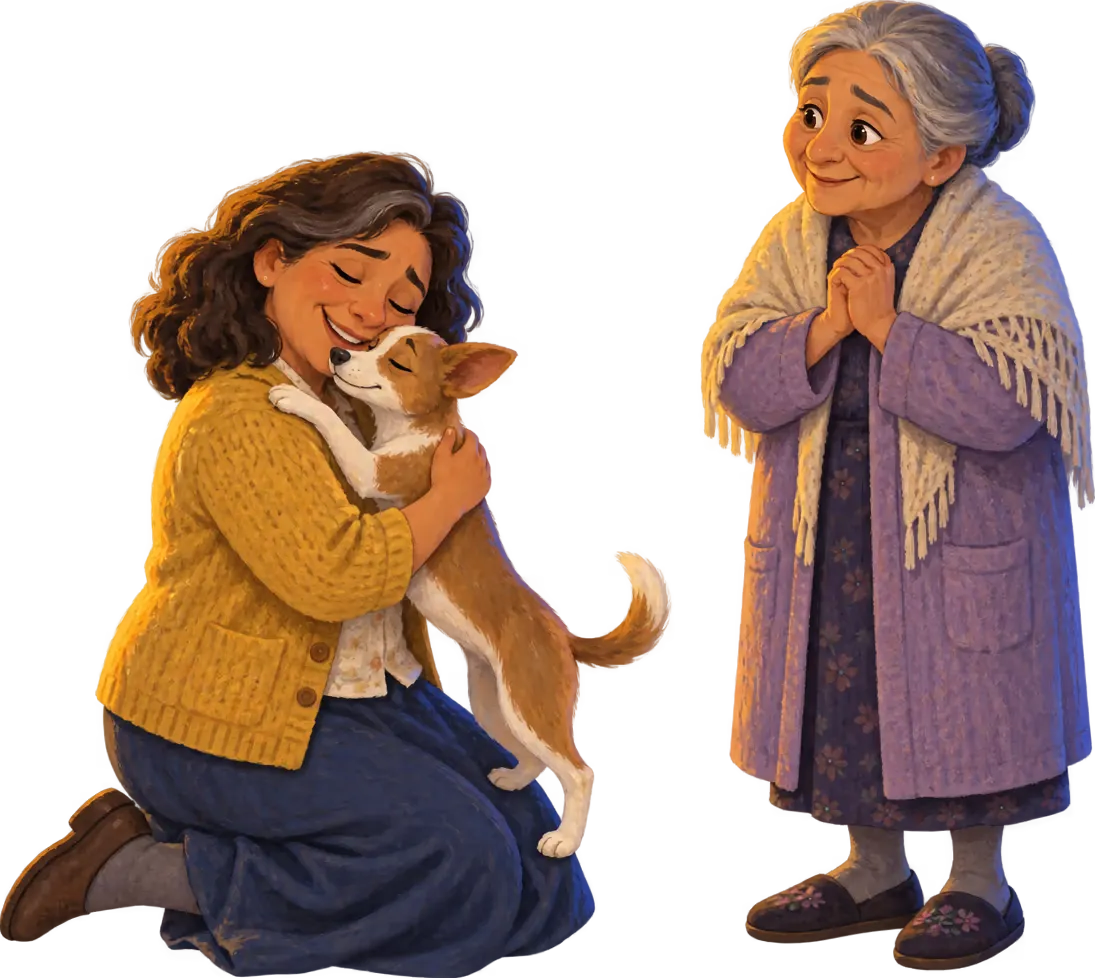

For a second, the world stopped. Claudia fell to her knees and Pepita ran toward her. She threw herself into her arms with such force that she almost knocked her to the ground. And then both cried—yes, Pepita too, with those high-pitched whimpers that dogs make when they’re overwhelmed with emotion.
“My baby,” Claudia sobbed, hugging Pepita with all her strength. “My baby, I thought I had lost you forever.”
Pepita licked every inch of Claudia’s face, as if she wanted to make sure it was really her, that she had really found her again.
The woman who had found Pepita watched the scene with a smile and tears in her own eyes.
“It’s beautiful,” she said softly. “The love between you is evident. Take good care of her.”
“I will,” Claudia promised. “I’m never going to let her get lost again.”
Claudia profusely thanked the woman, insisted on giving her a reward that the woman gently refused, and finally returned home with Pepita in her arms, hugging her as if she were the most precious treasure in the world.
When they arrived home, Rocky jumped with joy seeing his playmate back. He ran in circles around Claudia and Pepita, barking excitedly.
And Lucy, from her corner, lifted her head. For a moment, her eyes and Pepita’s met. And in that moment, something happened. Something changed.
Pepita saw Lucy—really saw her—perhaps for the first time. She saw the patience in those sad eyes. She saw the kindness in that dog who had never harmed her, who had never taken anything from her, who had simply wanted to be part of the family as much as she did.
And Pepita felt something new: shame. And with shame, came understanding.
Chapter 8: A New Beginning
The days after Pepita’s return were of adjustment and healing. Claudia watched the three dogs more closely, making sure doors were always closed, that no one could get lost again.
But she also noticed something different in Pepita.
The little dog no longer growled when Lucy approached. She no longer interposed herself aggressively when Claudia petted the older dog. In fact, one afternoon, something extraordinary happened.
Claudia was sitting in the patio, enjoying the afternoon sun. Lucy, as always, was lying not far away. Pepita and Rocky had been playing, running all around with their characteristic energy.
Suddenly, Pepita stopped. She looked at Rocky, then at Lucy, and then trotted toward where the older dog was. Lucy lifted her head, cautious, expecting the usual growl or rejection.
But it didn’t come.
Instead, Pepita approached and, with a timid movement, touched her nose to Lucy’s. It was the dogs’ greeting, a way of saying “hello” and “I accept you.”
Lucy blinked, surprised. Then, slowly, she wagged her tail.
And then, incredibly, Pepita lay down next to Lucy. Not too close, there was still some distance. But it was a beginning.
Claudia watched the scene with tears in her eyes. “Oh, my girls,” she whispered. “Finally.”
Days turned into weeks, and the relationship between Pepita and Lucy continued to improve. They would never be as close as Pepita and Rocky—that special bond of playmates was unique. But they learned to coexist in peace. Sometimes they even lay near each other under the sun.
Pepita had learned a valuable lesson during those days lost on the street: love doesn’t divide, it multiplies. Claudia didn’t love her less for also loving Lucy and Rocky. The home wasn’t smaller for having more inhabitants. In fact, it was bigger, warmer, more full of life.
And then something happened that no one had anticipated.
One night, after Rocky was also brought inside (Claudia had decided he also deserved to sleep indoors), Pepita was called to spend the night inside the house.
“Come, Pepita,” Claudia called. “You’re going to sleep inside with me.”
Pepita trotted happily inside. Claudia had prepared a soft little bed for her at the foot of her own bed, a comfortable and cozy place.
Pepita settled into her bed, but something didn’t feel complete. She looked around, restless. And then her eyes fell on something: a sock. One of Claudia’s socks that had been left on the floor next to the bed.
Without thinking much about it, Pepita grabbed the sock with her mouth and carried it to her bed. She curled up with it, hugging it like a puppy hugs its mother.
And so she fell asleep, with the sock pressed against her body.
Claudia noticed and smiled tenderly. “Do you like my sock, Pepita?”
From that night on, it became a ritual. Every night, when Pepita was called to sleep inside, she would look for one of Claudia’s socks. Not just any sock—it had to have her human mom’s scent. And she would carry it to her bed like a “comfort object,” that object of comfort that small children often have.
Sometimes, Claudia would wake up in the morning and find Pepita curled up not in her little bed, but in the big bed, at her feet, still with the sock between her paws.
“You’re unique, Pepita,” Claudia would say, scratching behind her ears. “A dog with a comfort sock. I’ve never seen anything like it.”
But for Pepita, that sock was more than just a simple object. It was the physical connection to Claudia’s love. It was the reminder, every night, that she was safe, that she was home, that she was loved.
And after having been lost and scared on the streets, that reminder was everything.
Epilogue
Years passed in Claudia’s house. The three dogs lived together in harmony—not perfect, because perfection doesn’t exist, but real and full of love.
Rocky grew to be almost the size of Lucy, though his energy never diminished. Lucy, already older when she arrived, eventually became slower, calmer, but always with that patient dignity that characterized her.
And Pepita… Pepita became the wise dog of the house. She was no longer the jealous and insecure puppy she had been. She had learned that true love has room for everyone.



Every night, when Claudia called her to sleep, Pepita repeated her ritual. She would look for a sock—it always had to be one of Claudia’s—and carry it to her bed. And there she would stay, with her comfort object, feeling safe and loved.
Claudia often told her friends about it. “My Pepita sleeps with a sock,” she would say with an affectionate laugh. “Like a baby with their blanket. It’s the cutest thing I’ve ever seen.”
And it was cute. But it was also a testimony of resilience, of how hearts can heal, of how love can transform even the most wounded.
Pepita had arrived as a street dog, desperately seeking a home. She had faced her own demons of jealousy and insecurity. She had lived through the terror of being lost and alone. And she had come out the other side not just surviving, but more loving, wiser, more complete.
And every night, with her sock in her mouth and the warmth of her family around her, Pepita would fall asleep knowing a simple but profound truth: she was exactly where she was meant to be.
The Lesson
Pepita’s story teaches us powerful lessons about love, family, and personal growth.
About jealousy and insecurity: Pepita shows us that jealousy often comes from fear—fear of losing what we have, fear of not being enough, fear that love is a limited resource that can run out. But the truth is that love doesn’t work that way. The human heart, and also that of animals, has an infinite capacity to love. Loving one doesn’t mean loving another less.
About second chances: Everyone deserves a second chance, both to be loved and to love better. Lucy arrived after being abandoned, and instead of becoming bitter, she continued to be gentle. Pepita arrived from the street, and although at first her fears made her selfish, she eventually learned to open her heart. Every day is an opportunity to be a better version of ourselves.
About finding comfort: Pepita’s sock is more than a cute curiosity. It’s a symbol of how we all need something that makes us feel safe, especially when we’ve known insecurity. There’s no shame in needing comfort, in having something or someone that reminds us we’re safe and loved.
About loss and return: Sometimes we need to lose something to realize its true value. Pepita had to get lost, had to experience the fear of the street again, to fully understand how fortunate she was. And when she returned, she came back changed, with a gratitude and appreciation she hadn’t had before.
About compassion: Claudia is the heart of this story. Her infinite compassion, her ability to see beyond herself and open her heart and home to animals that no one else wanted, is a reminder that the world needs more people like her. Not just people who love their own pets, but people who see every creature in need as worthy of love and care.
In a world that can often be cold and indifferent, Pepita’s story reminds us that true love—whether from human to animal or animal to animal—has the power to transform lives. That homes are built not with walls, but with open hearts. And that it’s never too late to learn to love better.
And sometimes, all we need to sleep peacefully is the equivalent of our own “sock”—that tangible reminder that we are loved, that we belong, that we’re home.
Dedicated to all animal rescuers, to all people who open their hearts and homes to the abandoned and forgotten. And especially to every Pepita, Lucy, and Rocky in the world—may they all find their sock and their home.